




Virtual teams face unique challenges. Three intentional practices can strengthen alignment, trust, communication and performance across distance.
Many remote workers have not returned to the office, and may never do so. As remote work becomes more common, the importance of building and maintaining effective virtual teams is more important than ever. On the positive side, virtual teams reduce meeting costs, provide greater flexibility in scheduling, combat climate change, allow us to leverage the best talent regardless of location, and more easily access new and different points of view.
At the same time, virtual teams introduce unique challenges. It’s difficult enough getting a team to work well together face-to-face—just go back and watch a Group Night episode of American Idol. When team members are in different time zones, separated by distance, and accustomed to different cultural norms, it’s even harder. Research by Professor Hayward Andres at Portland State University indicates that virtual team productivity and satisfaction is significantly lower than that of face-to-face teams. The model below highlights why virtual teams often struggle.
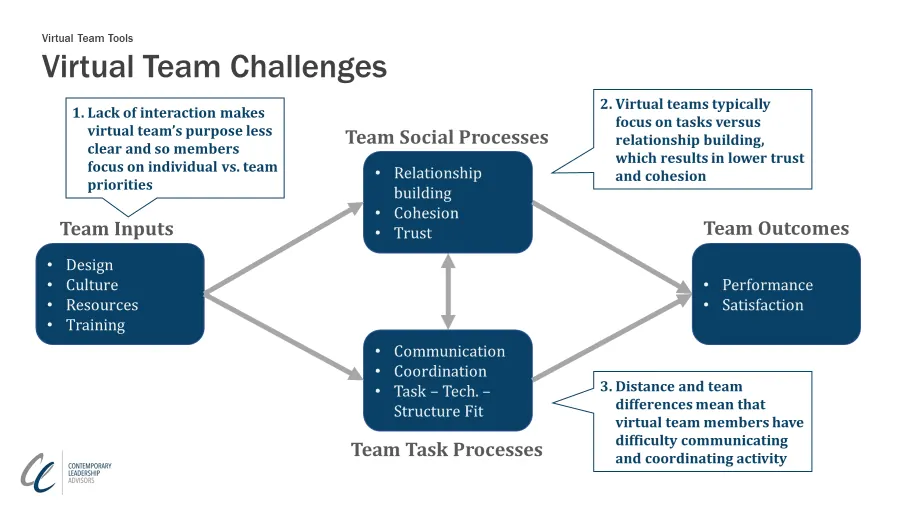
In our experience, the best virtual teams overcome these challenges using three specific practices.
1. Assume Nothing and Spell Out Everything
Too often virtual team members are focused on different agendas. This isn’t because they don’t want to be a good team member; it’s because the lack of interaction makes it harder to know what other team members want to accomplish. In the absence of a common understanding, virtual team members revert back to what’s important to them individually and make the false assumption that this is also what’s important to their teammates.
Alternatively, the best virtual teams assume nothing and spell everything out. They establish a team charter from the start that articulates the team’s goals, clearly defines who will do what, defines success metrics, and identifies team norms. According to Andy Czuchry, a Senior Faculty Member at the Institute for Contemporary Leadership, virtual teams can make objectives and measures explicit using the following template.
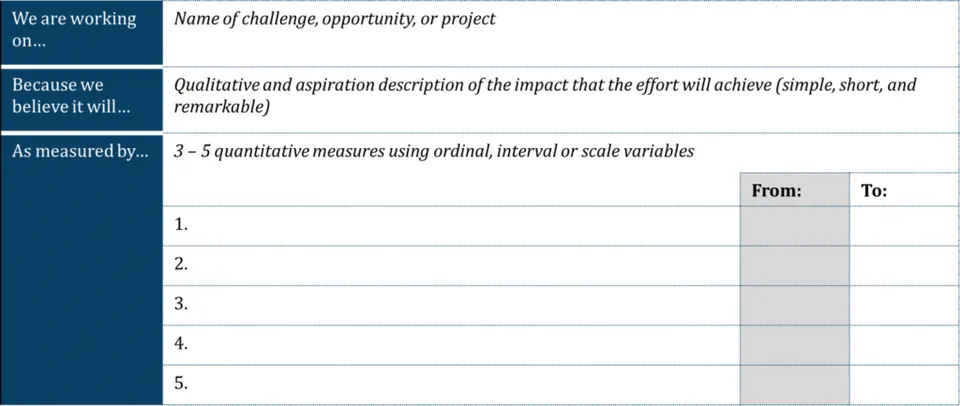
Documenting the team’s measures in this way drives alignment and provides the team with a framework for evaluating progress on an ongoing basis and knowing when they need to change course to achieve their goals.
2. Build Trust by Increasing Social Interaction
Virtual teams establish trust the same way any team does: by consistently engaging in trust-building behaviors. The difference is that the best virtual teams are intentional about checking in with team members to better understand how the team is doing and what can be improved.
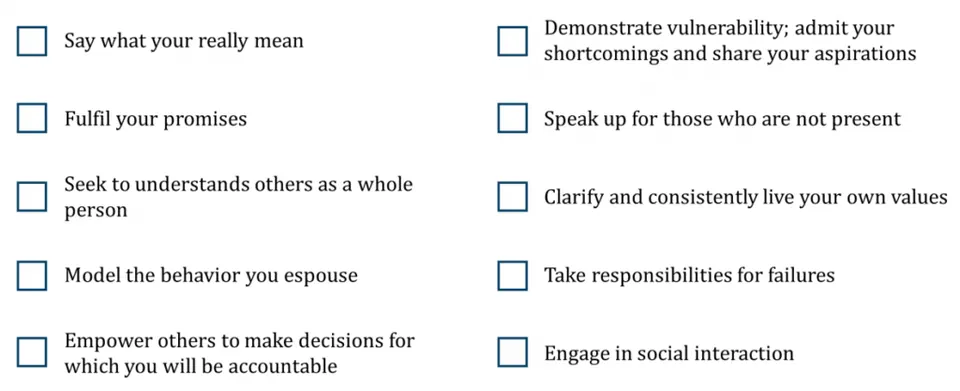
A key challenge for virtual teams, however, is limited social interaction. It’s hard to play laser tag when you are hundreds of miles apart. That said, virtual teams can bake non-work-related “chit chat,” or social discussions, into their agendas. This might entail celebrating a recent milestone or asking team members to share a recent personal event. Additionally, while virtual teams may not be able to go bowling together, they can engage in a host of virtual games such as Minecraft or World of Warcraft.
3. Establish Formal Communication Protocols and Then Over-Communicate
High-performing virtual teams conquer time and distance by establishing formal communication protocols and over-communicating. The best virtual teams publish agendas in advance, share pre-reads prior to the meeting, and send out meeting minutes with key decisions and follow-up actions. They also don’t let team members disappear. They create “virtual water coolers” and chat rooms to encourage communication and maintain a calendar for each team member to aid in scheduling across time and distance.
In addition, the best virtual teams leverage visual communication mediums, such as screen sharing and video conferencing. Interestingly, though, they use these tools in a slightly different way. In our experience, the best virtual teams require that team members video conference into the meeting on their own versus from a conference room with other team members. Insisting that everyone participates individually breaks down silos and increases inclusion. The impact of this simple shift can be quite powerful on the team’s cohesion and productivity.
Finally, we’re increasingly seeing virtual teams modify meeting times. Instead of starting on the hour, they start meeting five minutes later but ask team members to use those five minutes to individually prepare for the discussion. On the flip side, they end the meeting ten minutes early and participants use the extra time to consolidate their thinking and capture notes. These virtual teams maintain that when individuals put in a little extra time before and after the meeting, it streamlines group discussions and dramatically improves outcomes.
COVID-19’s disruption to our personal and business lives is significant and painful. Perhaps one small but powerful silver lining will be an improvement in how we work together virtually.